BathymetryCoverageBase
- class s100py.s102.v2_1.api.BathymetryCoverageBase(recursively_create_children=False, **kywrds)
Bases:
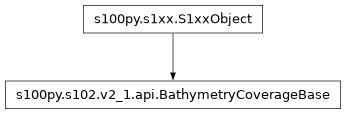
S1xxObjectThis is the Group.NNN object that contains the grid data in a values dataset and other metadata about the grids.
4.2.1.1.1 and Figure 4.4 of v2.0.0 also see section 12.3 and table 12.5
Attributes Summary
sequence of character strings From 4.2.1.1.1.11, The attribute axisNames has the value class Sequence<CharacterString> that shall be used to assign names to the grid axis.
From 4.2.1.1.1.10, The attribute dimension has the value class Integer that shall identify the dimensionality of the grid.
From 4.2.1.1.1.12, The attribute extent has the value class CV_GridEnvelope that shall contain the extent of the spatial domain of the coverage.
From 4.2.1.1.1.4, The attribute minimumDepth has the value type Real and describes the lower bound of the depth estimate for all the depth values in S102_BathymetryValues record.
From 4.2.1.1.1.7, The attribute minimumUncertainty has the value type Real and describes the lower bound of the uncertainty of the depth estimate for all the depth values in S102_BathymetryValues record.
From 4.2.1.1.1.3, The attribute minimumDepth has the value type Real and describes the lower bound of the depth estimate for all the depth values in S102_BathymetryValues record.
From 4.2.1.1.1.6, The attribute minimumUncertainty has the value type Real and describes the lower bound of the uncertainty of the depth estimate for all the depth values in S102_BathymetryValues record.
sequence of s102 Vectors From 4.2.1.1.1.9 in S102 v2.0.0 The attribute offsetVectors has the value class Sequence<Vector> that shall be a sequence of offset vector elements that determine the grid spacing in each direction.
From 4.2.1.1.1.8, The attribute origin has the value class DirectPosition which is a position that shall locate the origin of the rectified grid in the coordinate reference system.
From 4.2.1.1.1.13, The attribute sequencingRule has the value class CV_SequenceRule (ISO 19123) that shall describe how the grid points are ordered for association to the elements of the sequence values.
From4.2.1.1.1.14, The attribute startSequence has the value class CV_GridCoordinate that shall identify the grid point to be associated with the first record in the values sequence.
The grids for depth and uncertainty.
Methods Summary
add_data(key, value)The attribute axisNames has the value class Sequence<CharacterString> that shall be used to assign names to the grid axis.
Gets all the non-standard keys that are contained in this object currently as well as all the standard keys (S100/HDF5 style names) that could be added.
Override this method if the dtype of compound dataset items is important
get_data(key)get_hdf5_from_file(file_obj)get_s1xx_attr(s1xx_name)Returns the S100 (HDF5) names for the things that are listed in the specs for this class.
Returns a list of properties that are lists (children based on S1xxCollection).
This function autodetermines the properties implemented (which have get/set @properties and _hdf_name associated)
This function autodetermines the HDF5 or xml names and their associated property names.
Override this method if the data types of attributes/groups/dataset items is important
Override this method if the write order of attributes/groups/dataset items is important
initialize_properties([...])Calls the create function for all the properties of the class.
read(group_object)Given an h5py.File or a h5py group then read the data based on the encoded S100+ spec.
read_simple_attributes(group_object)Reads the standard simple types (strings, ints, floats, datetimes, enums) from the given group as specified by the class specs.
set_datetime_attribute(val, hdf_name, date_type)set_enum_attribute(val, hdf_name, enum_type)Function to set an attribute that is an enumeration type using either it's string or numeric value or enumeration instance.
set_s1xx_attr(s1xx_name, val)Creates a blank, empty or zero value for values
write(group_object)write the contained data and all it's children into an HDF5 file using h5py.
write_as_xml(etree_object)write_simple_attributes(group_object)Attributes Documentation
- axis_names
sequence of character strings From 4.2.1.1.1.11, The attribute axisNames has the value class Sequence<CharacterString> that shall be used to assign names to the grid axis. The grid axis names shall be “Latitude” and “Longitude” for unprojected data sets or “Northing” and “Easting” in a projected space
- dimension
From 4.2.1.1.1.10, The attribute dimension has the value class Integer that shall identify the dimensionality of the grid. The value of the grid dimension in this product specification is 2. This value is fixed in this Product Specification and does not need to be encoded
- extent
From 4.2.1.1.1.12, The attribute extent has the value class CV_GridEnvelope that shall contain the extent of the spatial domain of the coverage. It uses the value class CV_GridEnvelope which provides the grid coordinate values for the diametrically opposed corners of the grid. The default is that this value is derived from the bounding box for the data set or tile in a multi tile data set
- maximum_depth
From 4.2.1.1.1.4, The attribute minimumDepth has the value type Real and describes the lower bound of the depth estimate for all the depth values in S102_BathymetryValues record. This attribute is required. There is no default
- maximum_uncertainty
From 4.2.1.1.1.7, The attribute minimumUncertainty has the value type Real and describes the lower bound of the uncertainty of the depth estimate for all the depth values in S102_BathymetryValues record. This attribute is required. There is no default
- minimum_depth
From 4.2.1.1.1.3, The attribute minimumDepth has the value type Real and describes the lower bound of the depth estimate for all the depth values in S102_BathymetryValues record. This attribute is required. There is no default
- minimum_uncertainty
From 4.2.1.1.1.6, The attribute minimumUncertainty has the value type Real and describes the lower bound of the uncertainty of the depth estimate for all the depth values in S102_BathymetryValues record. This attribute is required. There is no default
- offset_vectors
sequence of s102 Vectors From 4.2.1.1.1.9 in S102 v2.0.0 The attribute offsetVectors has the value class Sequence<Vector> that shall be a sequence of offset vector elements that determine the grid spacing in each direction. The data type Vector is specified in ISO/TS 19103. This attribute is required. There is no default.
- origin
From 4.2.1.1.1.8, The attribute origin has the value class DirectPosition which is a position that shall locate the origin of the rectified grid in the coordinate reference system. This attribute is required. There is no default
- sequencing_rule
From 4.2.1.1.1.13, The attribute sequencingRule has the value class CV_SequenceRule (ISO 19123) that shall describe how the grid points are ordered for association to the elements of the sequence values. The default value is “Linear”. No other options are allowed. (note that for S100: Only the values “linear” (for a simple regular cell size grid) and “Morton” (for a Quad Tree Grid) shall be used for data that conforms to this standard.)
- start_sequence
From4.2.1.1.1.14, The attribute startSequence has the value class CV_GridCoordinate that shall identify the grid point to be associated with the first record in the values sequence. The default value is the lower left corner of the grid. No other options are allowed.
- values
The grids for depth and uncertainty.
4.2.1.1.2.1 S102_BathymetryValues semantics
The class S102_BathymetryValues is related to BathymetryCoverage by a composition relationship in which an ordered sequence of depth values provide data values for each grid cell. The class S102_BathymetryValues inherits from S100_Grid
4.2.1.1.2.2 values
- The attribute values has the value type S102_BathymetryValueRecord which is
a sequence of value items that shall assign values to the grid points.
There are two attributes in the bathymetry value record, depth and uncertainty in the S102_BathymetryValues class. The definition for the depth is defined by the depthCorrectionType attribute in the S102_DataIdentification class. The definition of the type of data in the values record is defined by the verticalUncertaintyType attribute in the S102_DataIdentification class
- write_format_str = '.%02d'
Methods Documentation
- add_data(key, value)
- axis_names_create()
The attribute axisNames has the value class Sequence<CharacterString> that shall be used to assign names to the grid axis. The grid axis names shall be “Latitude” and “Longitude” for unprojected data sets or “Northing” and “Easting” in a projected space.
- dimension_create()
- extent_create()
- get_all_keys()
Gets all the non-standard keys that are contained in this object currently as well as all the standard keys (S100/HDF5 style names) that could be added.
- Return type:
list
- get_compound_dtype()
Override this method if the dtype of compound dataset items is important
- Return type:
A list of dtype, None otherwise.
- get_data(key)
- get_hdf5_from_file(file_obj)
- get_s1xx_attr(s1xx_name)
- get_standard_keys()
Returns the S100 (HDF5) names for the things that are listed in the specs for this class.
- Returns:
The S102 HDF5 group/attribute/dataset names from this object that will be written or read from an HDF5 file. e.g. BathymetryCoverage or westBoundLongitude etc.
For the class “Root”: [‘BathymetryCoverage’, ‘Group_F’, ‘TrackingListCoverage’]
- Return type:
list
- get_standard_list_properties()
Returns a list of properties that are lists (children based on S1xxCollection). Basically a way of finding which items will be named <name>_001, <name>_002 etc
- Returns:
The property names that will have auto-generated names based on their index in a list.
- Return type:
list
- classmethod get_standard_properties()
This function autodetermines the properties implemented (which have get/set @properties and _hdf_name associated)
- Returns:
Names of the properties implemented.
For eample class “Root” might have (for S102): [‘bathymetry_coverage’, ‘feature_information’, ‘tracking_list_coverage’]
- Return type:
list
- get_standard_properties_mapping()
This function autodetermines the HDF5 or xml names and their associated property names. Keys are the s100 (HDF5 spelling) strings and the values are the python style naming.
- Returns:
dictionary of xml element names as keys and property names as values.
For the class “Root”: {‘BathymetryCoverage’: ‘bathymetry_coverage’, ‘Group_F’: ‘feature_information’, ‘TrackingListCoverage’: ‘tracking_list_coverage’}
- Return type:
dict
- get_write_dtypes()
Override this method if the data types of attributes/groups/dataset items is important
- Return type:
A list of tuples having key names and type, None otherwise.
- get_write_order()
Override this method if the write order of attributes/groups/dataset items is important
- Return type:
A list of key names if order is important, None otherwise.
- initialize_properties(recursively_create_children=False, overwrite=True)
Calls the create function for all the properties of the class. Default values will be created for each attribute that is expected to be contained in this object.
For example, say a class has simple attributes of ESPG code (int) and locatilty (str) and then a class made from S1xxObject called “extents” which has east and west inside it.
Calling initialize_properties(recursively_create_children=False) would result in EPSG=0, locality=”” and an instance of the “extents” class but NO value (nothing would be written to HDF5) for east, west.
Calling initialize_properties(recursively_create_children=True) would result in EPSG=0, locality=”” and an instance of the “extents” class but with east=0.0 and wesst=0.0 as well.
Calling initialize_properties(recursively_create_children=True, overwrite=False) with an esiting dataset, say locality=”test” would result in EPSG=0 being made, locality=”test” being retained and an instance of the “extents” class with east=0.0 and wesst=0.0 as well.
- Parameters:
recursively_create_children – True = Create children for any child data that would have other children False = Only create data for immediate children of this instance
overwrite – True = Overwrite existing data with new default data False = Keep existing data if it exists but create new data otherwise
- Return type:
None
- maximum_depth_create()
- maximum_uncertainty_create()
- minimum_depth_create()
- minimum_uncertainty_create()
- offset_vectors_create()
- origin_create()
- read(group_object)
Given an h5py.File or a h5py group then read the data based on the encoded S100+ spec.
- Parameters:
group_object – The group (an h5py.File is a group too) to read from.
- Return type:
None
- read_simple_attributes(group_object)
Reads the standard simple types (strings, ints, floats, datetimes, enums) from the given group as specified by the class specs.
- Parameters:
group_object – The group (an h5py.File is a group too) to read from.
- Return type:
None
- sequencing_rule_create()
- set_datetime_attribute(val, hdf_name, date_type)
- set_enum_attribute(val, hdf_name, enum_type)
Function to set an attribute that is an enumeration type using either it’s string or numeric value or enumeration instance. Raises an ValueError if the value is not found.
- Parameters:
val – The value as a string, int or Enum().
hdf_name – The S100 name (hdf5 spelling).
enum_type – The class of enumeration to use if an instance needs to be created.
- Return type:
None
- set_s1xx_attr(s1xx_name, val)
- start_sequence_create()
- values_create()
Creates a blank, empty or zero value for values
- write(group_object)
write the contained data and all it’s children into an HDF5 file using h5py.
- Parameters:
group_object – An h5py.File or an h5py group object
- Return type:
None
- write_as_xml(etree_object)
- write_simple_attributes(group_object)
- __init__(recursively_create_children=False, **kywrds)